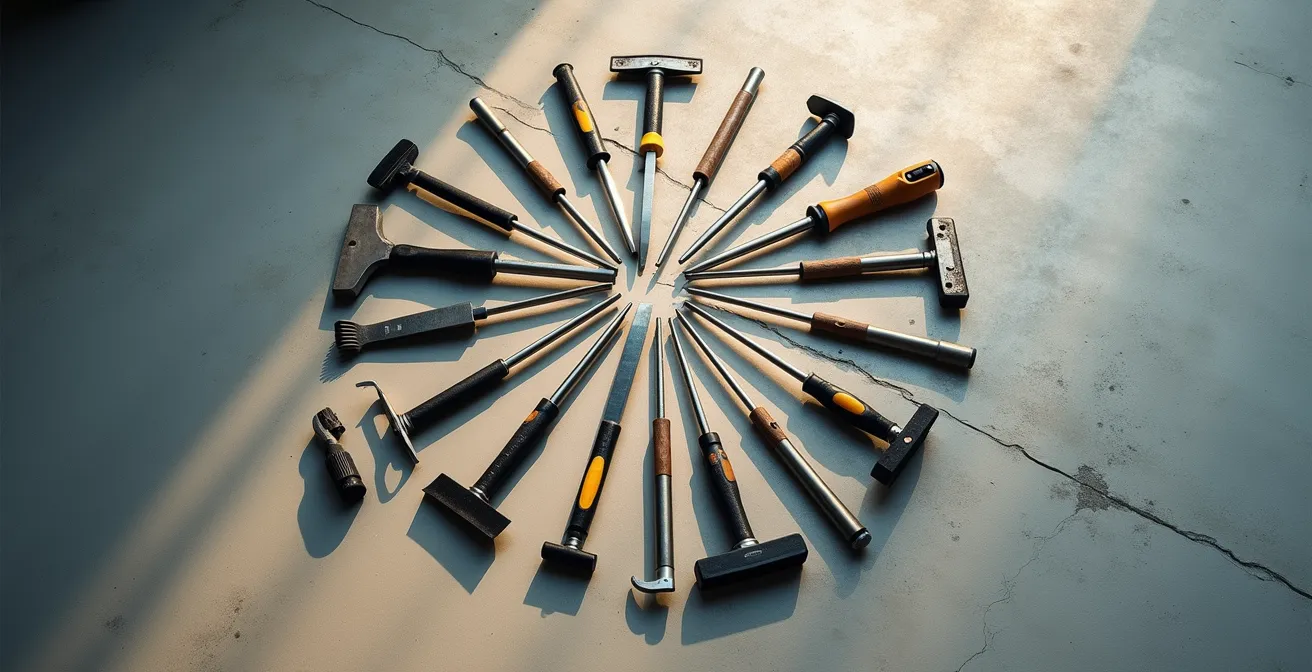
The difference between a roof that lasts 15 years and one that reaches 25 isn’t always visible from the ground. It’s often determined by the precision of the tools used during installation, the workflow efficiency they enable, and the invisible economic calculations that separate professional operations from improvised ones.
Understanding specialized roofing equipment requires looking beyond individual tools to see the interconnected systems they create. Professional contractors who invest in quality roofing supplies aren’t simply buying better hammers or more expensive nailers—they’re acquiring operational ecosystems that transform how projects unfold, how costs accumulate, and how client relationships develop.
The question isn’t whether specialized equipment costs more upfront. It does. The real question is whether the hidden expenses of generic alternatives—measured in labor hours, warranty callbacks, and shortened roof lifespans—justify that premium. This analysis explores the economic and operational dimensions that remain invisible until you calculate the total cost of ownership.
Professional Roofing Equipment Essentials
Specialized roofing tools function as integrated ecosystems where precision, compatibility, and workflow efficiency compound to create measurable advantages. The cost differential between professional and generic equipment disappears when calculating total ownership costs, which include hidden expenses like extended labor time, increased injury rates, and premature roof failures. Modern roofing operations depend on tool certification for regulatory compliance, insurance eligibility, and client trust—making equipment selection a strategic business decision rather than a procurement task.
Specialized Equipment as an Interconnected Ecosystem, Not Individual Tools
The conventional approach to roofing equipment treats each tool as an independent purchase decision. A nailer here, a compressor there, safety harnesses from one supplier, measurement systems from another. This fragmented thinking obscures the primary value proposition of professional-grade equipment: these tools are engineered to function as interdependent systems.
Modern roofing operations demonstrate this integration daily. Pneumatic nailers calibrated for specific compressor outputs ensure consistent depth across thousands of fasteners. Digital measurement systems sync with cutting equipment to minimize material waste. Fall protection components designed as matched sets eliminate the compatibility gaps that create safety vulnerabilities.
The industry has recognized this shift toward integrated systems. 73% of contractors use integrated digital systems in 2025, reflecting a fundamental change in how professional operations approach equipment acquisition. These systems don’t just perform individual tasks better—they reduce transition time between workflow stages, creating compound efficiency gains.
Workflow continuity represents one of the most significant but least visible benefits of equipment ecosystems. When a roofer using a specialized measurement system can transfer dimensions directly to a cutting station without manual transcription, they eliminate an error vector while saving 15-20 seconds per measurement. Multiply that across hundreds of cuts per day, and the time savings become substantial.
| Aspect | Integrated Systems | Standalone Tools |
|---|---|---|
| Workflow Efficiency | 40% faster transitions | Standard pace |
| Error Rate | 15% reduction | Baseline |
| Equipment Compatibility | 100% optimized | Variable |
| Training Time | Unified learning curve | Multiple protocols |
The hidden costs of incompatible ecosystems accumulate in ways that don’t appear on equipment invoices. Adapters fail. Pressure mismatches reduce tool lifespan. Workers spend cognitive energy managing compatibility issues rather than focusing on precision. These friction points don’t just slow projects—they introduce error opportunities that compromise installation quality.
Smart roofing systems exemplify this ecosystem approach at its most sophisticated. These platforms integrate monitoring, measurement, and execution tools into unified workflows that optimize every stage of installation. The efficiency gains stem not from any single component but from eliminating the gaps between them.
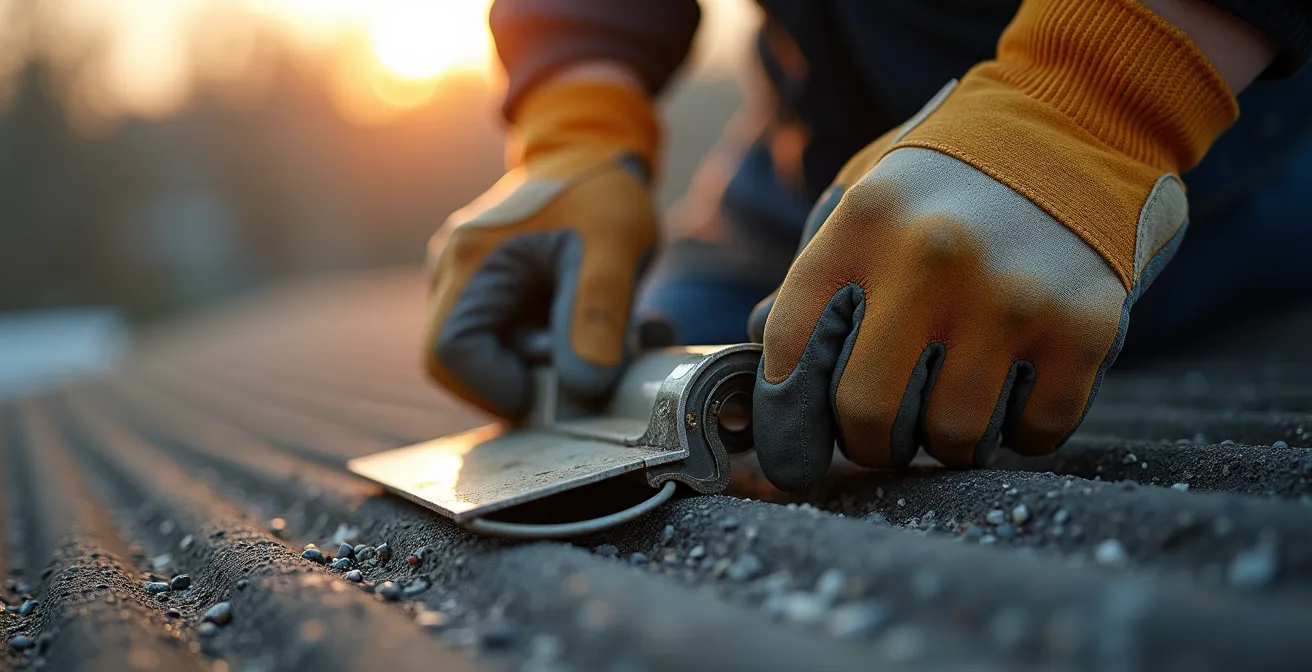
The tactile precision required for optimal equipment performance reveals itself in the small adjustments experienced professionals make throughout the day. Depth settings calibrated to substrate density, pressure adjustments for ambient temperature, tension modifications for different materials—these micro-optimizations compound into measurably superior outcomes.
Safety equipment illustrates the critical importance of system integration. A fall arrest system comprising anchor points, harnesses, and lanyards from compatible manufacturers undergoes unified testing to verify that failure points exceed required thresholds. Mix components from incompatible systems, and those safety margins become theoretical rather than verified.
The Hidden Cost Structure of Generic Equipment on Professional Sites
The sticker price comparison between professional and generic roofing equipment tells an incomplete story. A $400 pneumatic nailer looks expensive next to a $180 alternative until you calculate the hourly cost differential across a 2,000-square-foot installation. The real economic analysis requires examining total cost of ownership, not acquisition cost.
Labor efficiency represents the largest hidden cost differential. Generic equipment typically requires more physical effort, leading to faster fatigue and slower work pace. The performance gap widens throughout the day as cumulative fatigue degrades both speed and precision. What begins as a 10% efficiency difference in hour one becomes 30-40% by hour seven.
Studies examining total cost of ownership reveal dramatic differences when all factors enter the calculation. A comprehensive analysis shows 40% TCO reduction with specialized equipment when accounting for labor efficiency, error rates, and equipment longevity.
| Equipment Type | Labor Hours/1000 sq ft | Error-Related Callbacks | Worker Injury Rate |
|---|---|---|---|
| Professional Specialized | 16-20 hours | 2% | 1.5% |
| Standard Generic | 24-32 hours | 8% | 4.2% |
| Cost Difference | +40-60% | +300% | +180% |
The callback cost category deserves particular attention because it compounds direct expenses with reputation damage. A warranty claim requiring a return visit consumes 3-5 hours of labor, materials for repairs, and often involves conflict with a dissatisfied customer. When callback rates triple due to installation precision issues, the economic impact extends beyond immediate costs to affect referral rates and online reviews.
Medical costs and insurance implications create another layer of hidden expenses. Equipment-related injuries don’t just generate workers’ compensation claims—they increase future insurance premiums, trigger OSHA scrutiny, and potentially expose contractors to negligence liability. The 180% injury rate differential between equipment classes translates to substantial long-term financial consequences.
Break-even analysis reveals that specialized equipment typically pays for itself within 8-12 projects when calculating total ownership costs. A $1,500 investment in a professional nailer versus a $400 generic alternative creates a $1,100 premium. If that investment reduces labor time by 6 hours per project at a $75 hourly rate, the payback period is approximately 2.4 projects. Beyond that point, every project generates incremental savings.
Commercial facilities increasingly recognize these economics when evaluating roofing contractors. Sophisticated building managers understand that equipment quality directly impacts operational efficiency and project outcomes, making it a legitimate evaluation criterion during contractor selection.
Hidden costs to calculate in equipment selection
- Additional labor hours due to equipment limitations (40-60% increase with generic tools)
- Worker compensation claims from equipment-related injuries
- Project delays and associated penalty costs
- Customer satisfaction impact and lost referrals
- Training time for multiple incompatible systems
- Replacement frequency and downtime costs
Precision Tolerances and Their Direct Impact on Roof Longevity
The relationship between installation precision and roof performance operates through mechanisms that remain invisible for years. A fastener driven 2mm too shallow creates a wind vulnerability that won’t manifest until a severe storm tests the installation. A shingle alignment error of 5mm compounds across dozens of courses, eventually creating drainage patterns that accelerate weathering.
Specialized equipment controls these tolerance variables in ways generic alternatives cannot. Depth-sensing nailers maintain consistent fastener penetration across varying substrate densities. Laser-guided cutting systems ensure flashing components meet with precision that hand-cut alternatives rarely achieve. Temperature-controlled welding equipment for membrane systems prevents the molecular-level degradation that occurs when heat application varies.
The economic magnitude of precision failures becomes clear when examining industry-wide damage costs. Improper installation contributes significantly to roofing system failures, with $8-13 billion annually in hail-related shingle damage stemming partly from installation vulnerabilities that precision equipment would prevent.
| Precision Factor | Impact on Longevity | Cost Implication |
|---|---|---|
| Nail Depth Variance | ±5 years lifespan | 15-20% replacement cost |
| Shingle Alignment | ±3 years weatherproofing | 10% warranty claims |
| Flashing Seal Quality | ±7 years leak resistance | 25% repair frequency |
| Ventilation Accuracy | ±4 years material degradation | 20% energy costs |
Nail depth represents one of the most critical precision variables. Fasteners driven too shallow pull out under wind stress. Driven too deep, they compromise shingle integrity and create leak paths. The tolerance window is approximately 3-5mm—a range that manual control struggles to maintain across thousands of fasteners but depth-sensing pneumatic systems handle consistently.
Flashing installation exemplifies how precision compounds into long-term performance. The seal between flashing and roofing membrane must achieve molecular-level contact across the entire interface. Generic cutting tools create edge irregularities measured in tenths of millimeters—small enough to be invisible but large enough to create capillary gaps where water infiltrates over time.
Material science advances have made this precision increasingly important. Modern impact-resistant shingles utilize polymer-modified asphalt with specific performance characteristics that depend on proper installation. These engineered materials amplify both the benefits of precision installation and the penalties of imprecision.

The microscopic interface between roofing layers determines long-term weatherproofing effectiveness. Precision installation creates continuous contact that prevents water infiltration, while imprecise work leaves gaps that appear negligible but permit capillary action. These molecular-scale differences manifest as years of additional service life or premature failure.
Impact-resistant shingles are made from polymer-modified asphalt. This modified asphalt has greater flexibility, meaning it can handle impact better than traditional shingles. Insurance companies have been so impressed with this new roofing technology that some offer discounts for installing impact-resistant roofing products
– RoofSnap Editorial Team, 9 Revolutionary New Roofing Technology Trends
The insurance industry’s response to precision installation provides external validation of these performance differences. Carriers offer premium discounts for impact-resistant materials because they understand that proper installation—enabled by precision equipment—reduces claim frequency. This creates a measurable financial benefit for building owners who hire contractors using specialized equipment.
Temperature control in membrane welding illustrates another critical precision dimension. TPO and EPDM systems require heat application within specific temperature ranges to achieve proper molecular bonding. Generic heat guns lack the sensing and control systems to maintain these ranges consistently, leading to bonds that fail prematurely. Temperature-controlled welding equipment maintains precision automatically, ensuring each seam meets specification.
How Equipment Visibility Shapes Client Trust and Project Economics
Equipment serves dual functions on professional job sites. The obvious role involves executing installation tasks. The less apparent but equally valuable function involves signaling professionalism to clients, inspectors, and other stakeholders. This signaling effect creates tangible economic benefits that justify equipment investment independent of operational advantages.
Professionalism signaling operates through visible cues that clients use to assess contractor competence. A crew arriving with matched, well-maintained specialized equipment conveys systematic professionalism. That perception influences client decisions throughout the project lifecycle—from initial contractor selection through final payment negotiations.
The contractor certification landscape demonstrates this dynamic. Homeowners increasingly prioritize contractors holding certifications from reputable manufacturers, with many specifically seeking GAF Master Elite or Owens Corning Platinum certification status. These credentials signal commitment to professional standards, and specialized equipment serves as visible proof supporting those claims.
Price resistance diminishes when clients perceive visible professionalism markers. Contractors using specialized equipment report reduced negotiation friction and higher acceptance rates for premium pricing. The equipment itself becomes part of the value proposition, justifying rates that generic-equipment competitors struggle to command.
This phenomenon accelerates the sales cycle by reducing objection frequency. When potential clients see evidence of professional operations during estimation visits, their decision-making shifts from “Can I trust this contractor?” to “When can we schedule the project?” That transition has measurable economic value in terms of conversion rates and sales cycle duration.
Competitive differentiation becomes increasingly important as roofing services commoditize in certain market segments. When multiple contractors offer similar warranties and timelines, equipment quality provides a tangible differentiator. Sophisticated clients recognize that the tools used during installation directly affect outcomes, making equipment a legitimate selection criterion.
The relationship between visible professionalism and client retention extends beyond individual projects. Satisfied clients who observed professional equipment and operations become referral sources, creating compound value over time. This referral effect makes equipment investment a marketing expense as much as an operational one.
Commercial project bidding demonstrates equipment’s role in competitive positioning. Contractors detailing their equipment capabilities in proposals signal operational sophistication that influences selection committees. When two bids come in at similar prices, equipment specifications often break the tie.
Regulatory Compliance and Liability Mitigation Through Tool Certification
Key Takeaways
- Specialized roofing equipment functions as integrated ecosystems that compound efficiency gains beyond individual tool capabilities
- Total cost of ownership analysis reveals 40% savings with professional equipment when calculating hidden costs
- Installation precision directly correlates with roof longevity, creating measurable 5-10 year lifespan differentials
- Equipment quality serves as professionalism signaling that influences client trust and premium pricing acceptance
- OSHA certification requirements make specialized equipment mandatory for regulatory compliance and insurance eligibility
Regulatory Compliance and Liability Mitigation Through Tool Certification
The regulatory landscape surrounding roofing work has evolved from general safety guidelines to specific equipment certification requirements. This shift transforms equipment selection from a performance optimization decision into a legal compliance mandate. Contractors operating without properly certified equipment expose themselves to regulatory penalties, insurance exclusions, and civil liability.
OSHA standards establish minimum equipment requirements for fall protection, scaffolding, aerial lifts, and personal protective equipment. These regulations don’t merely suggest best practices—they create legal obligations with specific citation and penalty structures for non-compliance. The cost of a single OSHA violation often exceeds the investment required for compliant equipment.
| Equipment Category | OSHA Standard | Certification Required | Inspection Frequency |
|---|---|---|---|
| Fall Protection Systems | 29 CFR 1926.502 | Annual recertification | Before each use |
| Scaffolding | 29 CFR 1926.451 | Competent person setup | Daily inspection |
| Aerial Lifts | 29 CFR 1926.453 | Operator certification | Pre-operation check |
| Personal Protective Equipment | 29 CFR 1926.95 | ANSI compliance | Regular replacement schedule |
Insurance implications extend beyond workers’ compensation to general liability and professional indemnity coverage. Many commercial policies now include equipment certification requirements in their terms. Contractors using non-certified equipment may discover their insurance provides no coverage for resulting claims—transforming a covered incident into a business-ending liability exposure.
The construction industry faces persistent labor challenges, with 723,000 workers needed annually according to industry workforce analyses. This shortage makes worker retention critical, and safety performance directly affects retention rates. Workers increasingly refuse to work for contractors using substandard safety equipment, recognizing that their lives depend on equipment quality.
Commercial and government contracts frequently include equipment certification as a bid requirement. Contractors lacking properly documented, certified equipment become ineligible for these high-value projects. This creates market segmentation where equipment investment determines which project categories a contractor can pursue.
Legal protection in accident scenarios depends heavily on equipment documentation. When incidents occur, the first question investigators ask involves equipment certification and inspection records. Contractors who can produce comprehensive documentation demonstrating compliant equipment and proper maintenance protocols establish a strong defense against negligence claims.
OSHA sets and enforces workplace safety standards that employers must follow by law. For roofers, OSHA standards are critical for preventing accidents and injuries. Every employer in the roofing industry has a legal obligation to provide a safe workplace. They must train their workers and provide the necessary equipment to keep them secure on the job
– RoofSnap Safety Division, Safety Standards and Training in the Roofing Industry
The documentation burden associated with regulatory compliance creates ongoing administrative requirements. Equipment certifications require renewal, inspection records must be maintained, and training documentation needs regular updates. Specialized equipment typically includes integrated documentation systems that streamline these compliance tasks, while generic alternatives leave contractors creating manual tracking systems.
Insurance premium calculations increasingly incorporate equipment quality as a rating factor. Carriers recognize that contractors using certified, well-maintained specialized equipment present lower risk profiles. This translates to measurable premium differentials that compound annually, creating another dimension of equipment ROI.
Essential compliance documentation for equipment
- Manufacturer certification documents for all safety equipment
- Annual inspection records for fall protection systems
- Worker training certifications and competency assessments
- Equipment maintenance logs and replacement schedules
- Site-specific fall protection plans
- Emergency response procedures for equipment failures
The convergence of regulatory requirements, insurance mandates, and client expectations has transformed specialized equipment from a competitive advantage into a baseline operational requirement. Contractors attempting to compete with generic equipment increasingly find themselves excluded from markets, insurance coverage, and regulatory compliance.
Looking across the broader landscape of construction material choices, the same precision principles apply. Just as choosing quality windows requires understanding performance specifications beyond initial cost, roofing equipment selection demands analyzing total value rather than purchase price alone.
Frequently Asked Questions on Roofing Equipment
What makes roofing equipment “specialized” versus generic tools?
Specialized roofing equipment is engineered for specific roofing applications with precision tolerances, compatibility with industry-standard systems, and certifications meeting OSHA and ANSI requirements. These tools typically include depth control, pressure regulation, and safety features absent in generic alternatives. The specialization extends to how tools integrate into complete workflow ecosystems rather than functioning as standalone items.
How does equipment quality affect roof warranty coverage?
Many manufacturer warranties include installation quality clauses that require proper equipment use. Precision installation enabled by specialized tools ensures fastener depth, alignment, and sealing meet specifications necessary for warranty validity. Some manufacturers explicitly require certified installers using approved equipment classes, making generic tool use a potential warranty exclusion trigger.
What is the typical ROI timeline for investing in professional roofing equipment?
Total cost of ownership analysis shows specialized equipment typically achieves positive ROI within 8-12 projects when accounting for reduced labor hours, lower injury rates, and decreased callback frequency. The calculation varies based on project volume and size, but contractors completing 20+ projects annually often see payback within the first year through labor savings alone.
Can contractors mix equipment from different manufacturers while maintaining system benefits?
While possible, mixing manufacturers reduces the integrated ecosystem advantages that specialized equipment provides. Compatibility issues may arise with pressure settings, attachment systems, and workflow integration. Professional contractors typically standardize on compatible equipment families to maximize system synergies, though fall protection components should always come from unified, tested systems regardless of other equipment choices.