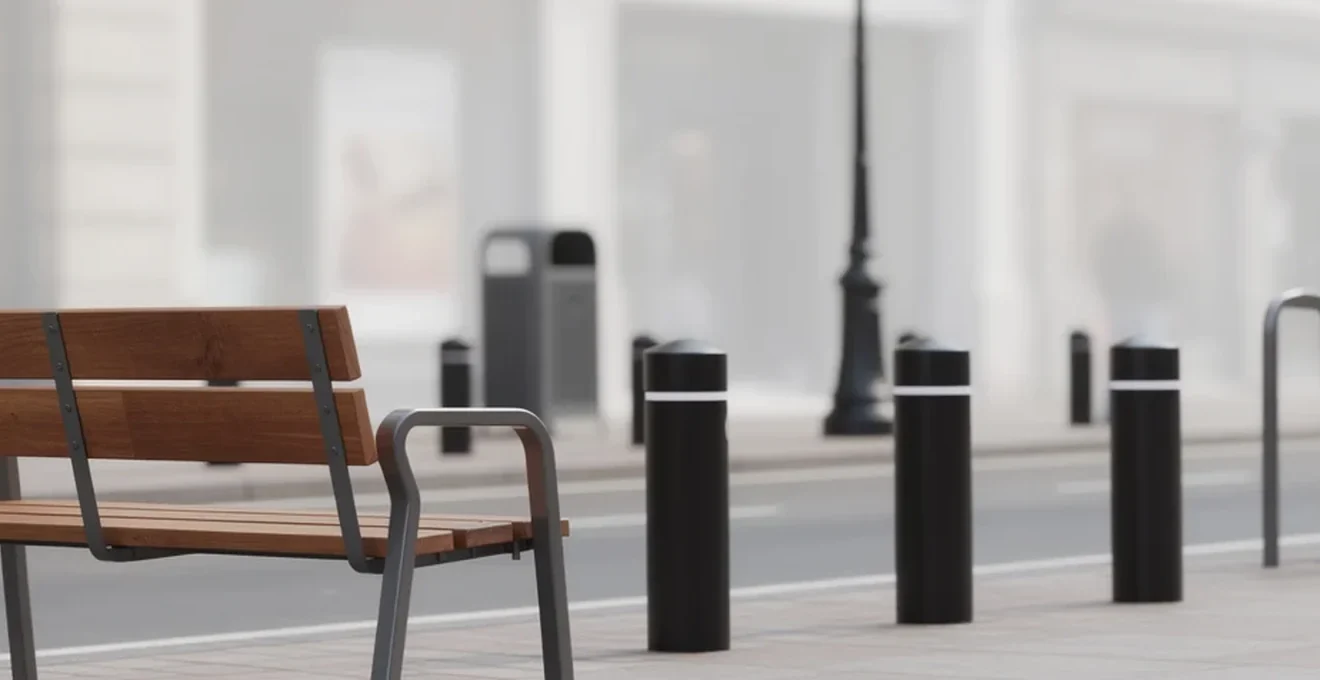
Street furniture is the physical infrastructure that shapes how we move through, rest in and interact with public spaces. From benches and bins to bollards and cycle stands, these items serve practical functions while contributing to safety, accessibility and the character of a place. Local authorities, urban designers and property developers rely on street furniture to support broader planning goals, including active travel, inclusive access and place-making. This guide explores the core categories of street furniture, the materials and regulations that govern their specification, and how individual elements such as seating, bollards and lighting work together to create functional, welcoming streetscapes. Whether you are procuring furniture for a heritage conservation area or a modern transport hub, understanding these fundamentals is essential to getting the specification right.
Defining street furniture in urban design
Street furniture refers to the fixtures installed in public spaces to support function, accessibility, safety and visual consistency. This includes seating, litter bins, bollards, cycle stands, planters and signage, all of which influence how people navigate and use the built environment. It is distinct from residential outdoor furniture, which prioritises comfort and aesthetics in private settings, and from indoor public-use furniture found in hospitals or airports. Street furniture must withstand heavier wear, constant environmental exposure and strict regulatory oversight, while also aligning with wider public realm objectives such as accessibility, sustainability and place-making.
Core categories: functional, decorative and protective elements
Street furniture generally falls into three broad categories. Functional items, such as benches, bins and cycle stands, serve a direct practical purpose for pedestrians and cyclists. Decorative elements, including planters and bespoke signage, contribute to visual identity and can help tie a streetscape together with coordinated finishes and colours. Protective features, such as bollards and railings, manage vehicle access and separate pedestrians from traffic. Many modern installations blend these categories: a planter might also act as a subtle barrier, while a bollard might incorporate solar-powered lighting for added visibility after dark.
Materials specification: cast iron, corten steel, hardwood and recycled plastics
Material choice has a direct impact on durability, maintenance costs and visual character. Cast iron is favoured for heritage-style benches and bollards due to its strength and traditional appearance, often paired with FSC-certified hardwood slats. Steel, particularly hot-dip galvanised or powder-coated variants, offers longevity and easier upkeep in urban and transport environments, and coatings should comply with ISO 12944-6 for corrosion resistance in harsh or coastal conditions. Recycled plastics and UV-stable polymers provide a low-maintenance, eco-conscious alternative for bins and seating, while treated softwoods and hardwoods remain popular where a natural finish is required without compromising performance. The right material depends heavily on context: a conservation area calls for a different specification to a busy transport interchange.
Regulatory standards: BS EN 1176 and local authority compliance
Street furniture in the UK is subject to a range of legislation and standards. The Highways Act 1980 governs the installation of furniture on public highways, covering obstructions, public rights of way and the need for local authority consent. The Equality Act 2010 requires that furniture, particularly seating, is accessible to all users, including those with mobility aids or visual impairments. Waste receptacles in high-traffic zones are increasingly specified against BS EN 13071-1:2008 for container strength, while play and recreational equipment standards such as BS EN 1176 apply where street furniture overlaps with play provision. Local authorities also publish their own public realm design codes, meaning compliance often means satisfying both national legislation and regional guidance simultaneously.
Seating solutions: benches and their design typologies
Benches remain one of the most visible and heavily used forms of street furniture, and their design has to reconcile comfort, durability and, in many cases, competing policy objectives.
Traditional timber benches vs contemporary concrete installations
Timber benches, often with cast iron or steel frames, are widely specified in heritage and conservation contexts because they align with historic streetscapes and soften harder urban materials. Contemporary concrete or precast installations, by contrast, are favoured in modern civic squares and transport hubs for their resistance to vandalism and minimal maintenance requirements. Neither approach is universally superior; the choice depends on local character, footfall and the level of upkeep a local authority can realistically commit to over the product’s lifecycle.
Ergonomic considerations and Anti-Loitering design debates
Comfortable seating supports rest and social interaction, particularly for older residents, parents with young children and people with mobility difficulties. Guidance suggests a seat height of around 450–480mm, with armrests and backrests to aid users getting in and out of a seated position. At the same time, some councils and property owners have adopted deliberately uncomfortable or segmented seating, sometimes referred to as anti-loitering or « hostile » design, to discourage rough sleeping or extended occupation of a space. This remains a contested area of public realm design, balancing safety and management concerns against inclusivity and the risk of excluding vulnerable groups from public space.
Case study: camden bench and its Multi-Functional purpose
One of the best-known examples of multi-functional seating design is the Camden Bench, developed for the London Borough of Camden. Its sculpted concrete form was designed to resist common problems associated with street furniture, including graffiti, skateboarding damage, drug concealment and unauthorised sleeping, while still providing a usable resting point for pedestrians. It illustrates how a single piece of street furniture can be engineered to address several practical and behavioural concerns simultaneously, rather than serving seating purposes alone.
Heritage cast iron benches in victorian park restorations
In parks and public spaces with historic significance, cast iron benches with timber slats remain a popular choice for restoration projects. Their traditional detailing helps preserve the visual character of Victorian-era parks and conservation areas, an approach also reflected in wider Historic England guidance, which encourages materials and designs sympathetic to local heritage. Products such as Broxap’s Eastgate Seat, which combines a cast iron frame with FSC-certified timber slats, are designed to meet this brief, offering a classic appearance alongside long-term durability suited to high-use public environments.
Bollards: traffic management and pedestrian safety
Bollards perform a deceptively wide range of functions, from subtle traffic calming to serious vehicle-security measures, and their design must reflect the level of risk and the character of the surrounding streetscape.
Fixed, removable and retractable bollard systems
Fixed bollards provide permanent separation between vehicles and pedestrians and are typically used where consistent restriction is required. Removable and lockable bollards allow temporary access for emergency services, deliveries or maintenance vehicles without compromising pedestrian safety when reinstated. Retractable systems, which can be lowered into the ground, offer similar flexibility for locations where vehicle access needs to be granted at specific times, such as market squares or pedestrianised high streets during off-peak hours.
Anti-terrorism hostile vehicle mitigation (HVM) rated bollards
In locations assessed as higher risk, such as busy pedestrianised city centres, transport hubs or areas with large public gatherings, bollards may need to meet Hostile Vehicle Mitigation standards. These products are engineered and tested to resist vehicle impact at specified speeds, providing a physical barrier against deliberate or accidental incursions into pedestrian zones. Specification of HVM-rated bollards typically involves security consultants alongside urban designers, ensuring that protective measures are integrated without creating an overly fortified or unwelcoming streetscape.
Solar-powered LED bollards for Low-Light visibility
Bollards increasingly incorporate solar-powered LED lighting to improve visibility in low-light conditions, particularly along cycle paths, park boundaries and pedestrian routes without existing street lighting infrastructure. This integration supports both safety and sustainability goals, reducing reliance on mains electricity while ensuring bollards remain clearly visible to drivers and pedestrians after dark.
Heritage-style bollards in conservation areas like bath and york
In historic cities and conservation zones, cast iron bollards with traditional detailing help maintain visual harmony with surrounding architecture. Products such as Broxap’s Manchester Cast Iron Bollard are designed for exactly this purpose, suiting pedestrianised public areas, heritage-led high streets and residential developments alike. In Liverpool, for example, the city council worked with Broxap to install a combination of fixed and removable bollards as part of a pedestrian zone transformation, tailoring the design to the city’s architectural character while meeting security requirements and improving pedestrian safety.
Lighting infrastructure and illumination strategy
Lighting is one of the most important safety-related elements of street furniture, shaping how confidently people use public space after dark.
Victorian-style lamp posts versus modern LED columns
Lamp post design ranges from ornate Victorian-style columns, often specified in heritage areas to preserve historic character, to minimalist modern LED columns favoured in contemporary developments and transport corridors. The choice mirrors the broader tension in street furniture specification between conservation-sensitive design and the practical benefits of newer technology, including energy efficiency and reduced maintenance.
Smart lighting networks and CMS (central management systems)
Many local authorities are moving towards centrally managed lighting networks, where individual columns are connected to a Central Management System. This allows remote monitoring of faults, adjustment of lighting levels based on time or footfall, and more efficient scheduling of maintenance. Such systems reflect a wider trend towards smart infrastructure across street furniture more broadly, including sensor-equipped bins and usage-monitoring technology.
Dark sky compliance and light pollution mitigation
Balancing safety with environmental responsibility means considering light pollution alongside illumination levels. Dark sky-compliant fittings direct light downward and reduce glare and skyward spill, helping preserve night-time visibility of stars in rural and semi-rural areas while still providing adequate lighting for pedestrians and road users. This is a growing consideration in lighting strategy, particularly in areas bordering national parks or other protected landscapes.
Waste management and cycling infrastructure
Bins and cycle infrastructure are central to keeping streets clean and supporting sustainable travel, and both are subject to specific regulatory and design considerations.
Litter bins: Vandal-Resistant designs and solar compactors
Litter bins in high-traffic locations, such as high streets, transport stations and stadiums, must be constructed from robust, impact-resistant materials, typically galvanised steel, cast iron or UV-stable polymers, and may require internal fire liners or ground-fixings to resist vandalism and withstand frequent emptying. Compliance with BS EN 13071-1:2008 for waste container strength is increasingly specified in public contracts. Bins must also be fully enclosed and weather-sealed to prevent rainwater ingress, reduce odour and deter vermin, in line with environmental health standards supported by DEFRA waste strategy guidance. Many councils now specify dual-compartment bins to separate general waste from recyclables, supporting the Resources and Waste Strategy for England. Placement matters just as much as construction: bins must avoid obstructing pedestrian routes or tactile paving, maintaining a minimum clear footway width of 1.5 metres in busy areas, near schools and around transport interchanges, since poor placement can invalidate pavement licences under post-2020 regulations.
Braintree District Council in Essex illustrated how thoughtful bin specification can support wider civic goals. As part of its « Green Heart of Essex » campaign, the council worked with Broxap to introduce 61 powder-coated galvanised steel bins in bright yellow, informed by WRAP data showing that brightly coloured bins increase usage. The order included bespoke wide-mouth bins for use from vehicles, mounted bins and slim litter bins, strategically placed along laybys on the A12, A120 and A131 to reduce roadside littering.
Sheffield stands and cycle parking provision in urban centres
Sheffield stands are widely regarded as the minimum standard for secure cycle parking, since they allow both the frame and wheels of a bicycle to be locked. In higher-risk locations, two-tier racks with locking mechanisms and CCTV coverage offer enhanced security. Cycle parking must also avoid obstructing pedestrian pathways, with a minimum clearance of 1.5 metres recommended around installations to accommodate all users, including those with mobility aids. Many modern schemes integrate additional features such as LED or solar-powered lighting, on-site repair stations with tools and pumps, and clear signage to aid wayfinding. Didcot Parkway Station in Oxfordshire demonstrates this approach in practice: as part of a forecourt redevelopment, Broxap supplied and installed the Apollo Two Tier Cycle Shelter with the Hi-Rise two-tier parking system, maximising capacity within a limited footprint while matching the station’s aesthetic and withstanding high usage.
Dog waste bins and public hygiene considerations
Dedicated dog waste bins support public hygiene in parks and residential streets, reducing the likelihood of fouling being left on paths or grassed areas. Like general litter bins, they need to be weather-sealed to control odour and prevent pest access, and should be positioned where they do not obstruct footways or create clutter around benches and play areas.
Integrating street furniture into placemaking and public realm strategy
Individual items of street furniture only deliver their full value when specified as part of a coherent public realm strategy, rather than in isolation.
Manual for streets guidance and shared space principles
The Manual for Streets provides guidance on designing residential and lightly-trafficked streets in a way that balances the needs of pedestrians, cyclists and vehicles. It informs decisions on furniture placement, such as ensuring litter bins do not obstruct pedestrian routes or tactile paving, and supports shared space principles where reduced kerb delineation and careful furniture positioning encourage more cautious vehicle behaviour and give pedestrians greater priority.
Accessibility compliance under the equality act 2010
The Equality Act 2010 requires that public spaces, including the street furniture within them, are accessible to disabled people. In practical terms, this shapes seat height and design, the contrast and detectability of bollards for visually impaired pedestrians, and the minimum clear widths maintained around benches, bins and cycle stands. Department for Transport guidance recommends a minimum clear width of 1.5 metres between bollards to accommodate wheelchair users and guide dogs, while bollards should be detectable by long canes and offer sufficient visual contrast with their surroundings. These requirements are not incidental details; they determine whether a public space is genuinely usable by all members of the community.
Sustainable procurement and local authority framework contracts
Public sector procurement of street furniture increasingly weighs sustainability criteria alongside cost and quality. This includes the use of recycled materials, low-carbon manufacturing processes and consideration of total cost of ownership rather than initial purchase price alone. Modular components, such as replaceable slats or fixings, and anti-graffiti or vandal-resistant coatings can reduce lifetime maintenance costs significantly compared with cheaper, non-serviceable alternatives. Social value is also a growing factor in framework contracts, with councils considering local job creation and community engagement alongside product specification. Suppliers offering long-term warranties, consultative specification support and end-of-life recyclability documentation help local authorities meet both budgetary constraints and circular economy commitments over the full lifecycle of an installation.