
Calgary’s professional services market runs on relationships built face-to-face. Networking events fill downtown venues weekly, the Calgary Business Expo draws hundreds of exhibitors twice annually, and decision-makers still expect tangible credentials when evaluating new partners. In this environment, the assumption that marketing has gone entirely digital misses a strategic reality: physical brand materials create credibility signals that digital presence alone cannot replicate.
According to research from Canada Post, nearly half of consumers—49 percent—view brands that send physical mail as more credible than those relying solely on digital channels. This credibility premium extends to all tangible marketing materials, from business cards exchanged at Chamber of Commerce mixers to brochures distributed at trade show booths and banners marking your storefront presence.
The question facing Calgary business owners preparing for growth opportunities is not whether print still matters, but how to orchestrate business cards, brochures, and banners as an integrated brand system. Each material type serves a distinct strategic function: cards establish immediate professional legitimacy during first encounters, brochures qualify prospects and extend sales conversations beyond initial contact, and banners maximize street-level visibility while demonstrating permanent market commitment. When aligned with your positioning and coordinated through consistent design and material choices, these three components amplify rather than compete with your digital presence.
- Print marketing’s enduring ROI in Calgary’s digital-first landscape
- Why does your first impression still happen offline with business cards?
- How do brochures transform browsers into qualified buyers?
- Banners and yard signs: maximizing street-level visibility under Calgary bylaws
- Which materials and finishes align with your brand positioning?
- Building a cohesive print strategy: from design brief to deployment
- Common questions about professional printing in Calgary
Print marketing’s enduring ROI in Calgary’s digital-first landscape
Digital marketing dominates budget conversations, yet Calgary’s business development culture remains firmly anchored in physical interactions. The city’s networking event calendar runs year-round through organizations like the Calgary Chamber of Commerce, industry-specific associations, and professional groups. Trade shows including the Calgary Business Expo create concentrated opportunities where hundreds of businesses compete for prospect attention in a single weekend. In these contexts, professional printing on boldsigns.com becomes the physical manifestation of your brand promise.
The tangibility of print materials triggers distinct psychological responses compared to digital encounters. A well-executed business card communicates production investment and attention to detail before a single word is exchanged. A professionally designed brochure left with a prospect maintains physical presence on their desk, unlike an email that disappears into crowded inboxes. A storefront banner signals permanence and market commitment that social media profiles cannot replicate.
This credibility advantage gains asymmetric value precisely because digital saturation has made online presence universal and therefore less differentiating. When every competitor maintains a website and LinkedIn profile, the marginal credibility gain from improving your digital presence diminishes. Professional print materials, by contrast, remain less common among emerging Calgary businesses, creating visible distinction when executed well.
The complementarity principle matters more than choosing between print and digital. Print materials function as trust anchors that drive prospects to digital channels for deeper engagement. A business card with a memorable design prompts website visits. A brochure highlighting specific capabilities encourages LinkedIn connection requests. Outdoor signage builds local awareness that amplifies the effectiveness of geotargeted digital advertising. Brands using both channels systematically outperform those relying exclusively on either approach.
Why does your first impression still happen offline with business cards?

Business cards carry disproportionate weight in professional credibility assessment. The moment of exchange creates a tactile evaluation opportunity where recipients unconsciously register paper weight, finish quality, printing sharpness, and design sophistication. These split-second impressions form perceptions about your business standards, attention to detail, and market positioning that subsequent interactions must either confirm or contradict.
Material choices communicate specific positioning signals. Standard weight card stock with basic printing suggests budget consciousness or early-stage operations. Premium weight stock with matte or soft-touch finishes conveys established professionalism and quality commitment. Specialty options including embossing, foil stamping, or textured papers signal premium positioning but risk appearing excessive for certain service categories.
The quality differential between low-cost online printing services and professional local providers manifests in perceptible ways. Online services typically use lighter stock weights, less sophisticated finishing options, and standardized templates that create visual similarity across different businesses. Professional Calgary printers offer heavier card stock options, superior color accuracy, specialized finishes, and design consultation that aligns material choices with strategic positioning.
| Positioning Goal | Recommended Materials | Finish Options | Approximate Calgary Cost (500 cards) |
|---|---|---|---|
| Accessible Professional | 14pt card stock, standard weight | Matte or gloss coating | $150–$250 |
| Established Expert | 16pt card stock, premium weight | Soft-touch matte, spot UV accents | $300–$450 |
| Premium Specialist | 18pt+ card stock, textured or cotton options | Embossing, foil stamping, edge coloring | $500–$800 |
Design mistakes undermine even premium printing quality. Common errors include cramming excessive information onto card faces, using multiple conflicting fonts, incorporating low-resolution logos that print poorly, and choosing color combinations with insufficient contrast for readability. Clean layouts with ample white space, a single professional typeface family, high-resolution graphics, and strategic use of color create more impact than elaborate designs executed poorly.
Functional durability matters for cards carried to multiple networking events. Lighter stocks bend and show wear quickly, communicating carelessness when retrieved from wallets or cardholders. Heavier stocks with protective coatings maintain appearance through repeated handling, ensuring your credentials look professional whether distributed at your first event or your fiftieth.
How do brochures transform browsers into qualified buyers?
Brochures serve distinct strategic functions that websites cannot fulfill. At trade shows and networking events, attendees browse dozens of booths and meet numerous vendors within compressed timeframes. They cannot meaningfully engage with every website on-site, but they can collect brochures for later review. This creates a filtering opportunity: prospects who invest effort carrying your brochure home have demonstrated initial interest worth nurturing.
The strategic value lies in prospect qualification rather than comprehensive information delivery. A brochure functions as a conversation framework that highlights specific capabilities, establishes your approach, and creates enough interest to prompt follow-up contact. The goal is not to answer every question but to position yourself as worth a deeper conversation after the event concludes.
Format decisions depend on sales cycle complexity and primary use contexts. Tri-fold brochures work effectively for straightforward service offerings presented at high-traffic events where prospects make quick collection decisions. The compact format fits easily into conference bags and provides sufficient space to communicate core value proposition, key differentiators, and contact pathways without overwhelming busy readers.
Multi-page brochures suit more complex offerings requiring explanation of methodology, credentials, case study examples, or service tier comparisons. These formats work better for face-to-face sales meetings where you guide prospects through content rather than relying on unassisted reading. The additional pages allow deeper storytelling but require stronger initial engagement to justify the reading investment.
Content architecture balances depth with scanability. Prospects reviewing materials collected at events spend seconds determining whether to engage further or discard. Headlines and subheadings need to communicate value quickly. Bulleted capability lists enable rapid scanning. Brief case examples or testimonials provide credibility without demanding sustained attention. The layout should facilitate both quick assessment and deeper reading for interested prospects.
Consider a professional services provider preparing for the Calgary Business Expo. A tri-fold brochure might devote the front panel to a compelling problem statement relevant to target clients, the three interior panels to solution approach and key differentiators, and the back panel to credentials and clear next steps. This structure allows booth visitors to grasp relevance within seconds while providing enough substance to differentiate from competitors using similar language.
Banners and yard signs: maximizing street-level visibility under Calgary bylaws
Outdoor signage generates cumulative visibility impossible to achieve through event attendance alone. Storefront banners, yard signs, and temporary event signage create repeated impressions among prospects who regularly travel past your location or event participation. This repetition builds familiarity and perceived permanence that single interactions cannot establish.
Calgary’s signage regulations create a compliance framework that businesses must navigate to avoid penalties and removal orders. The City of Calgary’s Temporary Signs on Highways Bylaw establishes placement restrictions, size limitations, and duration rules that apply to various sign types. Understanding these requirements prevents wasted investment in non-compliant signage that cannot be legally displayed.
Calgary signage compliance requirement: Signs cannot be placed within 15 meters of any intersection or within 30 meters of City bus shelters, transit benches, bus zones, LRT stations, or platforms. Advocacy messaging faces additional restrictions within 150 meters of schools if larger than 3.5 by 5 inches. Unauthorized signs face removal without notice.
Key Calgary signage bylaw thresholds: Temporary signs on highways must be removed within 14 days unless specifically authorized. Homeowner permission is required before placing signs on private property. Parks signage requires separate authorization under the Parks and Pathways Bylaw. Violations can result in fines and immediate removal.
The strategic distinction between temporary and permanent signage affects both compliance obligations and investment decisions. Temporary banners for events, promotions, or seasonal campaigns operate under different rules than permanent storefront signage. Temporary installations offer flexibility for testing locations and messages but require careful timeline management to avoid bylaw violations. Permanent installations require greater upfront investment and often involve additional permit processes but create ongoing visibility without recurring compliance management.
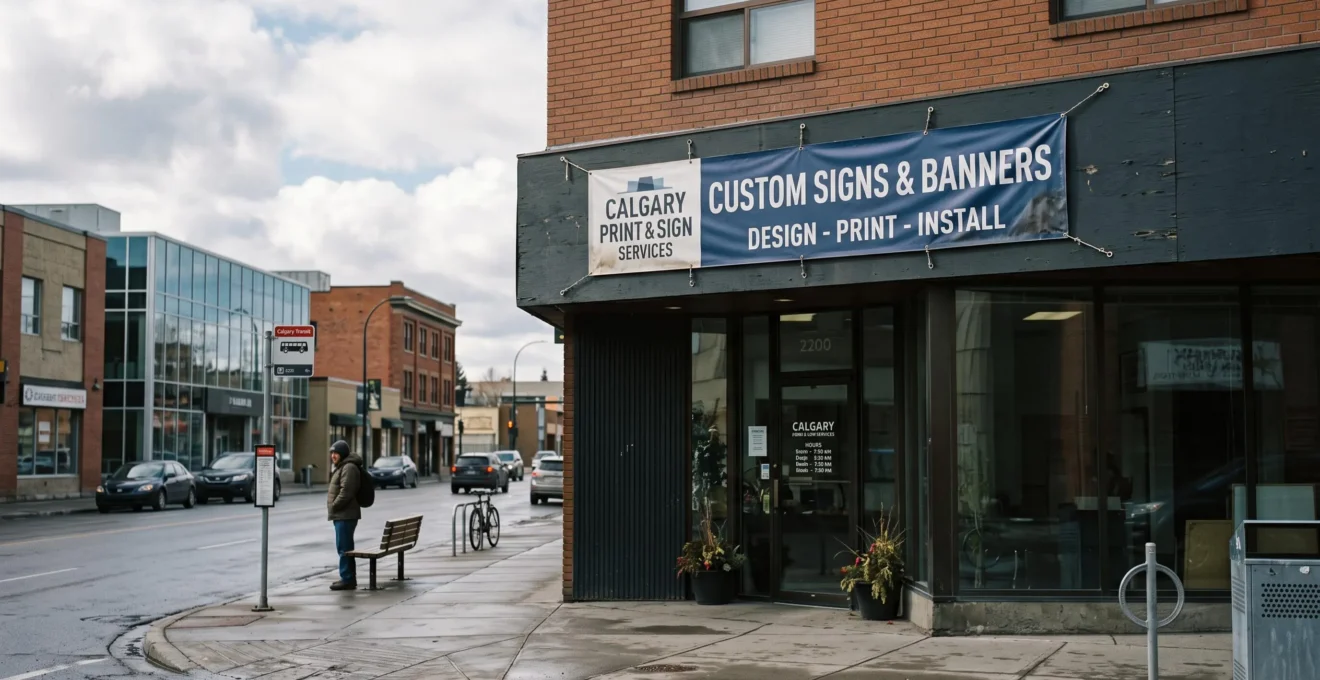
Effective placement strategies maximize visibility within compliance parameters. High-traffic pedestrian corridors, corner locations with multi-directional exposure, and positions near transit stops create repeated impressions among commuters following regular routes. The investment in compliant professional signage pays returns through cumulative awareness building rather than immediate conversion, making location selection critical for long-term ROI.
Local provider expertise offers compliance risk mitigation that online-only suppliers cannot provide. Calgary-based signage companies understand municipal bylaw requirements, navigate permit processes efficiently, and design installations that meet regulations while maximizing visibility. This local knowledge prevents costly mistakes including non-compliant sizing, prohibited placement, and materials inappropriate for Calgary’s weather conditions.
Which materials and finishes align with your brand positioning?
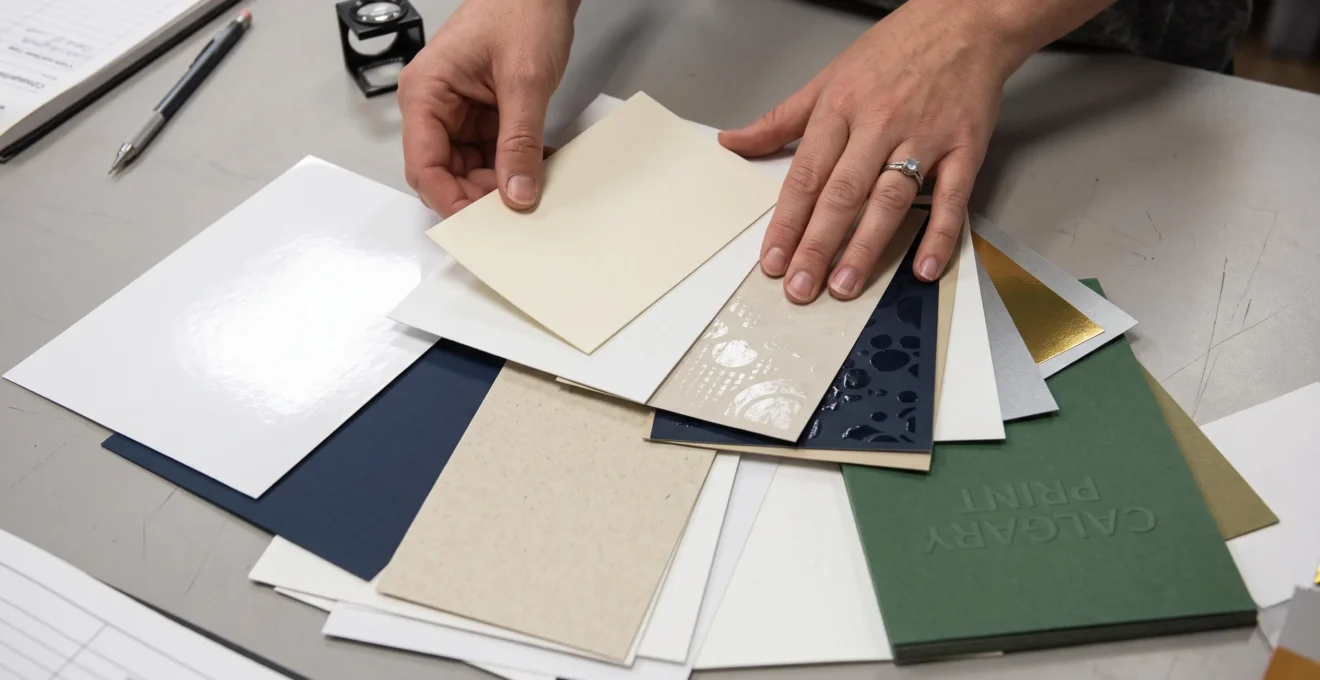
Material selection begins with strategic positioning rather than browsing available options. The positioning you want to occupy in prospect minds should dictate material requirements, reversing the typical approach of choosing from what suppliers offer. This positioning-first framework empowers business owners without design expertise to brief providers confidently and evaluate recommendations against strategic goals.
Premium professional positioning requires material choices that signal quality investment and attention to detail. Heavier card stock weights, matte or soft-touch finishes that feel substantial, and subtle specialty treatments like embossing or edge painting communicate that you maintain high standards across all business dimensions. For professional services firms competing with established players, these material choices create parity in perceived credibility that allows capabilities and relationships to become the differentiating factors.
Accessible expert positioning benefits from clean, modern materials that communicate professionalism without premium pricing signals. Mid-weight card stocks, crisp printing, and simple matte or gloss finishes achieve professional appearance while avoiding materials that might create affordability concerns for budget-conscious prospects. This positioning works effectively for consultants, coaches, and advisors targeting small business clients where value perception matters more than luxury signaling.
Innovative disruptor positioning allows bolder material experimentation including unusual sizes, non-traditional finishes, or unexpected color treatments. These choices risk appearing inappropriate for conservative industries but create memorability in sectors where differentiation and creative thinking represent competitive advantages. Technology consultants, creative agencies, and emerging category specialists can leverage distinctive materials to reinforce positioning claims.
Finish options impact perceived quality and brand attributes beyond basic printing. Matte finishes communicate sophistication and reduce glare for easier reading, working well for professional services and premium positioning. Gloss finishes create vibrancy and visual impact, suitable for retail-oriented businesses and creative services. Specialty coatings including soft-touch, spot UV highlighting specific elements, and textured finishes add tactile interest but increase costs substantially.
The consistency principle requires maintaining material quality tiers across all printed touchpoints. Investing in premium business cards while using economy brochures creates dissonance that undermines the credibility signal each piece should reinforce. Coordinated material choices across cards, brochures, and banners demonstrate systematic attention to brand presentation that prospects interpret as indicative of service delivery standards.
Cost-value relationships vary by material category. The incremental cost difference between standard and premium business card stock typically ranges from $100 to $300 for quantities suitable for a year of networking, a modest investment relative to the credibility impact. Brochure material upgrades create larger absolute cost differences but matter less when distributed selectively to qualified prospects rather than mass-produced for general distribution.
Building a cohesive print strategy: from design brief to deployment
Integrated print strategy treats business cards, brochures, and banners as interdependent system components rather than separate procurement decisions. This systematic approach ensures coordinated design language, efficient production scheduling, and budget optimization through consolidated provider relationships.
Sequencing decisions should reflect business stage and immediate growth priorities. New businesses typically start with business cards as the foundational tool for networking and initial business development. Cards enable immediate professional presence at modest investment, creating credentials for early relationship building. Brochures become valuable once sales conversations reach sufficient volume to justify production costs, typically after establishing initial client base and refining service positioning. Banners and outdoor signage follow when permanent location or regular event participation creates opportunities for cumulative visibility investment.
Provider selection criteria balance full-service capabilities against specialist expertise. Full-service Calgary printing companies handle design consultation, production across multiple material types, and coordinated brand system development. This consolidation simplifies project management and ensures visual consistency but may cost more than specialist providers focused on single material categories. Specialist providers offer deeper expertise in specific areas like large-format banners or premium business cards but require coordination across multiple vendor relationships.
Timeline planning for event-driven needs requires working backward from fixed deadlines. Consider a professional services provider preparing for Calgary Business Expo scheduled six weeks away. The timeline should allocate one week for design brief development and initial concepts, one week for design refinement and approval, two weeks for production allowing for potential delays, and one week buffer for delivery and quality verification before the event. Compressed timelines risk quality compromises or rush fees that undermine budget efficiency.
Budget allocation guidance for professional services businesses typically dedicates 15 to 25 percent of annual marketing budgets to print materials when active networking and event participation drive business development. For a consultant with a $15,000 annual marketing budget, this suggests $2,250 to $3,750 allocated across business cards, event brochures, and selective signage. This allocation allows premium business cards for ongoing networking, professional brochures for major events, and targeted banner investments for high-visibility opportunities.
Full-service local providers offer system integration advantages beyond individual product quality. Coordinated design ensures visual consistency across materials, consolidated production scheduling improves timeline reliability, and established relationships with Calgary suppliers who understand municipal compliance requirements reduce regulatory risk. These benefits matter particularly for business owners managing print strategy alongside operational responsibilities without dedicated marketing staff.
The six-week expo preparation scenario illustrates integrated execution. Week one involves briefing a full-service Calgary provider on positioning goals, target audience characteristics, and specific event requirements. Week two focuses on design concept review and refinement across coordinated business cards and tri-fold brochures. Weeks three and four handle production while the business owner finalizes booth logistics. Week five delivers materials with time for quality verification and minor adjustments if needed. Week six provides buffer capacity ensuring calm preparation rather than crisis management.
Common questions about professional printing in Calgary
What should I expect to pay for professional business cards in Calgary?
Professional business card pricing in Calgary typically ranges from $150 to $250 for 500 cards using standard premium card stock with basic finishes, $300 to $450 for premium weight stock with specialty finishes like soft-touch matte or spot UV, and $500 to $800 for luxury options including embossing, foil stamping, or specialty materials. These prices reflect local professional printers rather than budget online services, which may cost less but provide lower quality materials and standardized designs.
How long does it take to produce business cards, brochures, and banners in Calgary?
Standard production timelines in Calgary typically require 7 to 10 business days for business cards, 10 to 14 business days for brochures depending on quantity and finish complexity, and 7 to 10 business days for banners. Rush production options can reduce these timelines by 50 percent but typically add 25 to 50 percent to costs. For event deadlines, plan to initiate orders at least four weeks in advance to allow time for design development, revisions, production, and delivery with adequate buffer for unexpected delays.
Do I need to provide finished design files or can Calgary printers help with design?
Most professional Calgary printing companies offer design services either included in project pricing or available for additional fees. If you lack design expertise or finished files, working with providers offering design consultation ensures materials align with positioning goals and meet technical production requirements. Expect design services to add $200 to $500 for business card design, $400 to $800 for brochure design depending on complexity, and $300 to $600 for banner design. These investments prevent costly production errors and create professionally coordinated brand systems.
What are minimum order quantities for business cards and brochures?
Minimum order quantities vary by provider but typically start at 250 to 500 cards for business cards and 100 to 250 pieces for brochures. Smaller quantities usually carry higher per-unit costs due to setup expenses, while larger quantities reduce unit pricing through economies of scale. For new businesses, ordering 500 business cards provides a year’s supply for moderate networking activity, while 250 brochures suits selective distribution at targeted events rather than mass distribution.
What file formats and specifications do Calgary printers require?
Professional printers typically require print-ready PDF files with embedded fonts, CMYK color mode rather than RGB, minimum 300 dpi resolution for images, and appropriate bleed margins extending design elements beyond trim lines. Common mistakes include submitting RGB files that print with unexpected color shifts, low-resolution images that appear pixelated, and designs without bleed that create white borders after trimming. If you lack technical expertise to prepare files correctly, choosing providers offering design services prevents these production errors and ensures optimal print quality.
Professional print materials function as strategic investments rather than discretionary expenses when aligned with positioning goals and coordinated as integrated brand systems. Business cards establish immediate credibility during first encounters, brochures extend sales conversations and qualify prospects at events, and banners build cumulative visibility demonstrating market permanence. Calgary businesses preparing for growth opportunities gain competitive advantage by treating these three material types as complementary system components rather than independent procurement decisions.
The tangible credibility premium that print materials create becomes particularly valuable in markets saturated with digital presence where online channels no longer differentiate effectively. Understanding Calgary’s regulatory requirements for outdoor signage, selecting materials that signal appropriate positioning, and working with local providers who navigate compliance and production complexities transforms print strategy from uncertain expense to measurable brand-building investment.
For business owners approaching major visibility opportunities like the Calgary Business Expo or systematic networking campaigns, the framework outlined here provides actionable decision criteria for material selection, budget allocation, timeline planning, and provider evaluation. The goal is not perfect execution but strategic alignment between the impression your printed materials create and the market position you aim to occupy.